

Module 11: Crypto Regulations & Global Compliance
As cryptocurrency adoption grows worldwide, governments and regulators are racing to define rules for this new digital economy. While crypto was originally designed to be decentralized and borderless, it now intersects with traditional financial systems, national laws, and international compliance standards.
Understanding crypto regulations
How exchanges operate
How taxes are applied
Which coins are legal
How companies build blockchain products
How users protect themselves legally
1. Why Crypto Regulation Exists
Cryptocurrency introduced a new financial model that operates without banks or central authorities. While this innovation brought freedom and efficiency, it also created concerns for governments and institutions.
Regulation exists primarily to address:
Consumer Protection
To prevent:
Fraud
Scams
Market manipulation
Fake projects
Exchange collapses
Many users have lost funds due to hacks or deceptive schemes. Regulations aim to make platforms more accountable
Financial Stability
Governments want to ensure that crypto markets do not threaten traditional banking systems or national currencies.
Anti-Money Laundering (AML)
Crypto can be misused for:
Money laundering
Terrorist financing
Tax evasion
Rules help track suspicious activity while still allowing innovation.
Tax Compliance
Crypto profits are taxable in many countries. Governments need clarity on:
Capital gains
Trading income
Mining income
NFT sales
Regulation brings crypto into existing tax frameworks
2. What Is Crypto Regulation?
rypto regulation refers to the legal rules that govern:
Cryptocurrency trading
Blockchain businesses
Exchanges
Wallet providers
Stablecoins
DeFi platforms
NFTs
These laws define:
Who can operate legally
What licenses are required
How customer data must be protected
What reporting is necessary
How disputes are handled
Unlike traditional finance, crypto regulation is still evolving and varies significantly from country to country.
3. Key Areas of Crypto Regulation
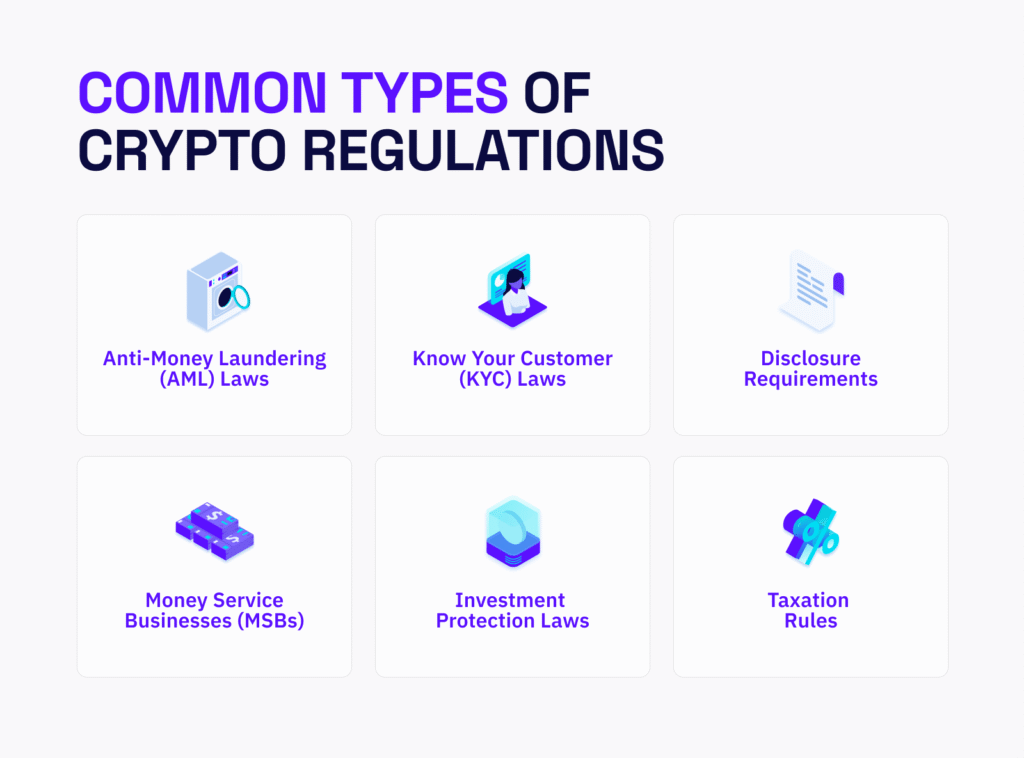
Most crypto regulations focus on a few major areas:
🔐 3.1 KYC (Know Your Customer)
Exchanges must verify user identity using:
Government ID
Proof of address
Biometric data
This prevents anonymous misuse and aligns crypto with banking standards.
🕵️ 3.2 AML (Anti-Money Laundering)
Platforms must:
Monitor transactions
Flag suspicious activity
Report to authorities when required
This integrates crypto into global financial crime prevention systems.
💼 3.3 Licensing & Registration
Crypto businesses often must register as:
Financial service providers
Virtual asset service providers (VASPs)
Money transmitters
Without licensing, companies can face shutdowns or fines.
📈 3.4 Securities Laws
Some tokens are considered:
Securities
Commodities
Utility tokens
This affects how they can be sold and traded.
🧾 3.5 Taxation
Governments define how crypto is taxed:
Capital gains tax
Income tax
Corporate tax
VAT or sales tax
Tax clarity is one of the most important aspects of regulation.
4. Global Regulatory Approaches
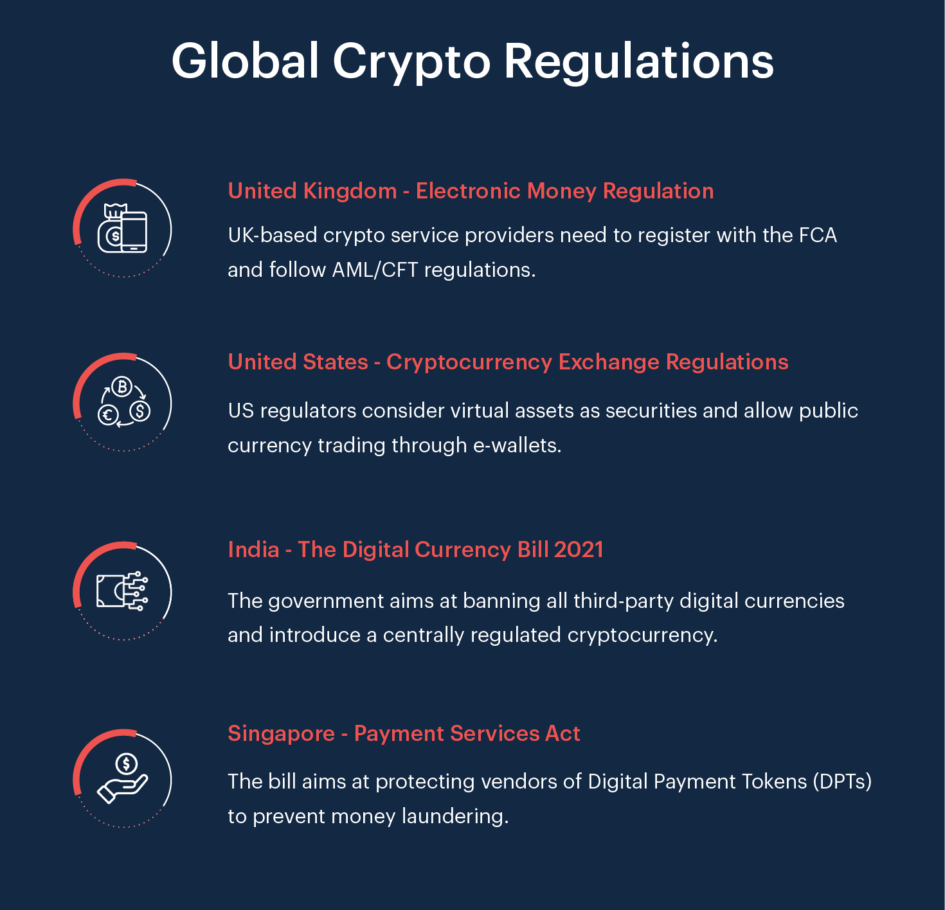
Different countries have adopted different stances toward crypto. These can be grouped into three main categories:
🟢 4.1 Crypto-Friendly Countries
Some countries actively encourage crypto innovation:
🇸🇬 Singapore
Clear legal framework
Strong consumer protection
Crypto treated as regulated financial service
🇨🇭 Switzerland
Known as “Crypto Valley”
Favorable blockchain laws
Supportive of startups
🇦🇪 United Arab Emirates
Special crypto zones
Regulatory sandboxes
Global crypto hub development
🇯🇵 Japan
Recognizes crypto as legal property
Strong exchange regulation
High security standards
These countries balance innovation with oversight.
🟡 4.2 Regulated but Restrictive Countries
Some nations allow crypto but under heavy regulation:
🇺🇸 United States
Complex regulatory structure
Multiple agencies involved
Strong enforcement actions
Ongoing debates over token classification
🇬🇧 United Kingdom
FCA regulates crypto firms
Marketing rules are strict
Consumer protection prioritized
🇪🇺 European Union
Introduced MiCA (Markets in Crypto Assets regulation)
Unified framework across EU countries
Focus on stablecoins and exchanges
These regions emphasize compliance and investor safety.
🔴 4.3 Countries with Bans or Heavy Limits
Some countries restrict or ban crypto activities:
🇨🇳 China
Banned crypto trading and mining
Promotes its own digital currency (CBDC)
🇮🇳 India (historically uncertain)
Mixed regulatory signals
High taxation
Legal but tightly controlled
🇪🇬 Egypt and others
Religious or financial concerns
Severe restrictions
However, even in these regions, underground or informal crypto usage may continue
5. Stablecoins & Regulation
Stablecoins (like USDT and USDC) pose special regulatory challenges because they are linked to national currencies.
Concerns include:
Reserve transparency
Financial stability
Banking integration
Cross-border payments
Many governments are drafting special rules for:
Stablecoin issuers
Reserve audits
Consumer redemption rights
Stablecoins are seen as bridges between crypto and traditional finance — and therefore tightly regulated.
6. Central Bank Digital Currencies (CBDCs)
In response to crypto growth, many countries are developing their own digital currencies.
CBDCs are:
Government-issued
Centralized
Controlled by central banks
Designed for national payment systems
Unlike crypto, CBDCs:
Do not provide decentralization
Do not offer anonymity
Are fully regulated
They represent a government-controlled version of digital money.
7. DeFi and Regulatory Challenges
Decentralized Finance creates new legal questions:
Who is responsible for a protocol?
Who enforces compliance in a decentralized system?
How are smart contracts regulated?
How are DAOs taxed or governed?
Because DeFi has no central company, regulators struggle to apply traditional rules.
Possible future solutions include:
Front-end regulation
DAO legal structures
Smart contract audits
Compliance layers in protocols
DeFi remains one of the most complex regulatory areas.
8. NFT Regulation
NFTs introduce questions about:
Copyright
Intellectual property
Royalties
Fraud
Tax classification
Governments are still determining:
Whether NFTs are securities
How NFT profits should be taxed
How creators should be protected
Some NFTs are treated as collectibles, others as financial assets.
9. Crypto Taxes: What Users Should Know
In most countries, crypto is taxable when you:
Sell crypto for fiat
Trade one crypto for another
Earn staking rewards
Mine crypto
Sell NFTs
Common tax categories:
Capital gains tax
Income tax
Business tax
Keeping records is essential:
Transaction history
Wallet addresses
Trade prices
Dates
Fees
Failure to report can result in penalties
10. Compliance for Exchanges & Platforms
Crypto platforms must comply with:
KYC laws
AML rules
Data protection regulations
Reporting obligations
Consumer protection laws
This includes:
User verification
Transaction monitoring
Freezing suspicious accounts
Cooperation with authorities
While this reduces anonymity, it increases legitimacy and trust
11. The Role of International Organizations
Global coordination is growing through organizations such as:
FATF (Financial Action Task Force)
IMF
World Bank
They promote:
Global standards
Travel Rule compliance
Shared reporting
Cross-border cooperation
Crypto regulation is becoming increasingly international rather than national.
12. Risks of Over-Regulation
While regulation is necessary, excessive control can:
Drive innovation offshore
Push users into illegal markets
Slow technological development
Create monopolies
Reduce privacy
Finding balance is the key challenge for governments.
13. The Future of Crypto Regulation
The future will likely bring:
Clearer token classifications
Global standards
Regulated DeFi
Better consumer protections
Integration with banks
More legal certainty
We may see:
Crypto banks
Licensed DAOs
Tokenized stocks
Regulated NFT markets
Blockchain-based compliance systems
Crypto will not disappear — it will evolve within legal frameworks